Accessible Justice and Community Roots: Judge Pro Tem James W. Armstrong Jr. Joins The Mother’s Justice Show
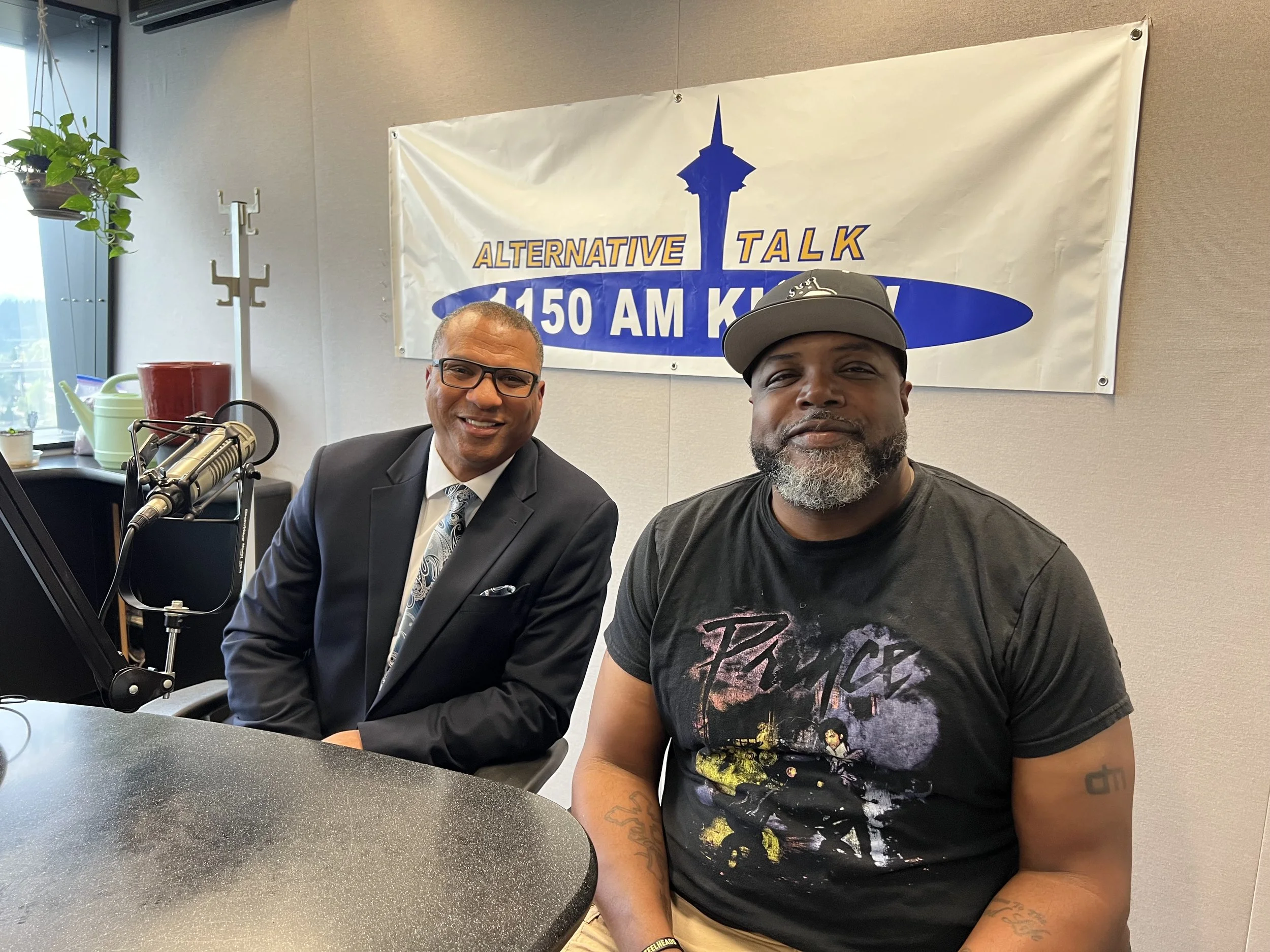
James W. Armstrong Jr. (left) and Omari Salisbury (right) sit in the Hubbard Radio Seattle Studio on Monday.
On a recent episode of The Mother’s Justice Show on 1150 AM KKNW, guest host Omari Salisbury sat down with James W. Armstrong Jr., a judge pro tempore in Puyallup Municipal Court and Pierce County District Court, and a candidate for Pierce County District Court, Position 8.
Armstrong outlined a judicial philosophy he grounded in accountability, rehabilitation, and community, while drawing lines between courtroom decisions, social services, and the lived realities of the “least of us.”
From Solo Practice to the Bench
Armstrong has practiced law for 26 years, including 20 years as a solo practitioner focused on workers’ compensation and social security disability. He began pro tem work in 2022, later serving as presiding judge in Bremerton Municipal Court, an experience he said confirmed that judging was more than a job to him.
“You realize you find your passion when you go to work, but it doesn’t feel like work… I was in the court all day and in my office at night, but it didn’t feel like work because during the day, when I was adjudicating those cases on the bench, it was my passion.”
Pro tem judges, he explained, carry the same legal authority as elected or appointed judges when they take the bench. Armstrong emphasized that this role is rooted in trust.
“You don’t want to let yourself down, your colleagues down, or the judge who put you in that position [down],” he said.
He also noted how representation matters in judicial pathways.
“The number of judges who are African American… there’s a small number. And we can always improve with regards to diversity… The court system needs to look like the people that are coming before the judge,” he said.
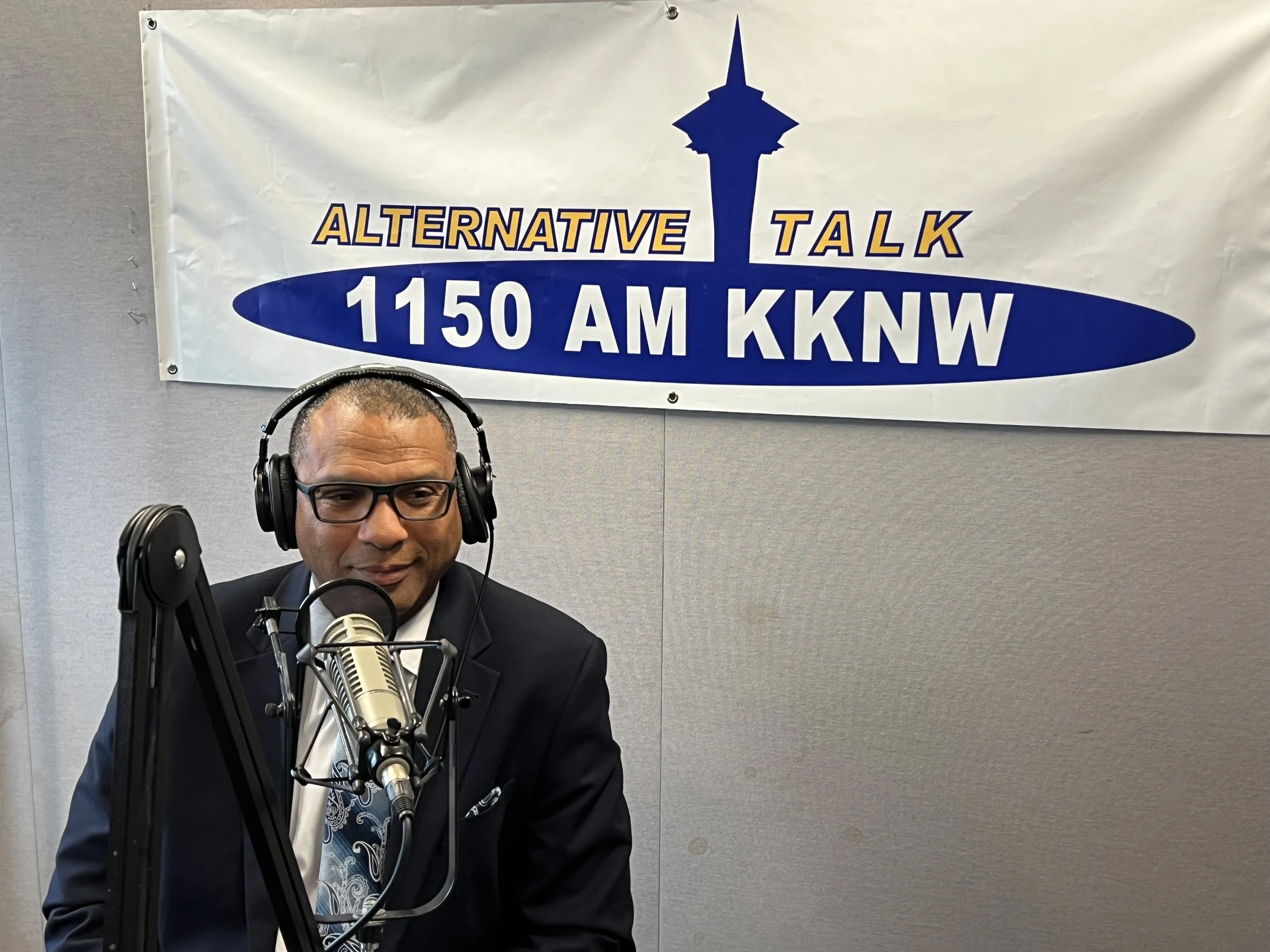
James W. Armstrong joins The Mother’s Justice Show on Monday in the Alternative Talk 1150 KKNW Studio.
‘The People’s Court’: Why Municipal and District Courts Matter
Armstrong repeatedly returned to the importance of municipal and district courts, the level where most people first encounter the criminal legal system.
“The people’s court—it’s like back in the day with Judge Wapner and Judge Judy,” he said
Unlike superior court, which handles felonies, municipal and district courts focus on misdemeanors and gross misdemeanors—offenses such as theft, criminal trespass, malicious mischief, domestic violence misdemeanors, and lower-level assaults.
A Three-Part Judicial Philosophy
When Salisbury asked Armstrong directly about why Pierce County voters might consider supporting him, Armstrong laid out his three-part judicial philosophy: accountability, rehabilitation, and community.
Breaking it down, Armstrong stressed that accountability remains essential when a defendant is convicted or enters a plea.
“There’s a plea bargain in front of you… or there’s been a jury trial, and someone’s found guilty, and you’re there to impose the sentence. You have to hold people accountable… whether it’s in-custody time or other anger management, consumer awareness, things of that nature,” he said.
He argued that accountability must be paired with rehabilitation, especially at the misdemeanor level. This includes making sure to identify underlying issues that contribute to a person’s violations of the law and impose mental health assessments.
“If they’re not dealt with, the community is going to suffer from more thefts, more trespasses, more domestic violence, more assaults,” he said.
For Armstrong, addressing root causes like mental health, chemical dependency, and housing instability, is key to slowing what he and Salisbury repeatedly referred to as the “revolving door” of the criminal legal system.
The third pillar, community, is where Armstrong places youth outreach and mentorship:
“You have to have kids at the courthouse…have them see exactly what you’re doing, have them participate in what you’re doing,” he said, reflecting on his experience inviting high school students to the courtroom when he was presiding in Bremerton. “If you can plant a seed with a child like that who never thought about being a lawyer or a judge, you never know where that’s going to take them.”
Disability, Work, and ‘The Least of Us’
Armstrong’s experience in workers’ compensation and social security disability law heavily informed how he viewed the people who appear before him in court, he said.
“My practice deals with the least of us,” he said, identifying clientele with disabilities or injuries that prevent them from working and whose claims are in limbo or have been denied. He drew a direct connection between those clients and defendants in municipal and district court.
“We’re dealing with the same kinds of people here… substance abuse issues, mental health issues, psychological issues… which has contributed to them committing certain crimes,” he said.
On social security disability, Armstrong explained how the system can punish people for trying to work part-time while disabled, threatening the strength of their cases. He described typical wait times of 18 to 19 months from application to a hearing.
“Next thing you know, you have no benefits, and a lot of people are just destitute living in their cars while they reapply,” he said. “By the time they get to a hearing… they’ve lost everything.”

Access, Law School, and Representation
Armstrong also spoke candidly about law school costs and access for underrepresented communities. A graduate of Seattle University School of Law and a product of its Access Admissions Program, he questioned whether he would encourage younger people to attend law school at current prices.
“If someone were to ask me today, should I go to law school? I’d have to pause… because of the extraordinary cost,” he said.
He pointed to alternatives, including Washington’s law clerk route, where people can study under a practicing attorney and sit for the bar without taking on law school debt.
“You can be taught under a lawyer for four years and not actually incur the cost of law school. Take the bar after that four years and become a practicing attorney without incurring the cost of law school,” he said.
Transparency and Trust in the Courts
Asked how courts can maintain public confidence at a time of deep skepticism about institutions, Armstrong pointed to transparency and open doors. Armstrong summarized what he hopes to bring to Pierce County District Court.
“Reaching out and being close to the community has got to be a must at this level,” he said. “Accountability, imposing the sentence, but the rehab at this municipal court and district court level is very important to slow down the recidivism rates and to make the community safer.”
For more information about his campaign, Armstrong directed listeners to ArmstrongForJudge.com
Listen to Armstrong’s full interview on The Mother’s Justice Show here.
Tune in to The Mother’s Justice Show Mondays from 2 p.m. to 3 p.m. on 1150 AM KKNW.
Looking to book a space for your upcoming event? Check out Colman Commons for all your event space needs at colmancommons.com