Holding Space for Healing: Sean Goode Talks Mental Health and Youth Violence on The Mother’s Justice Show
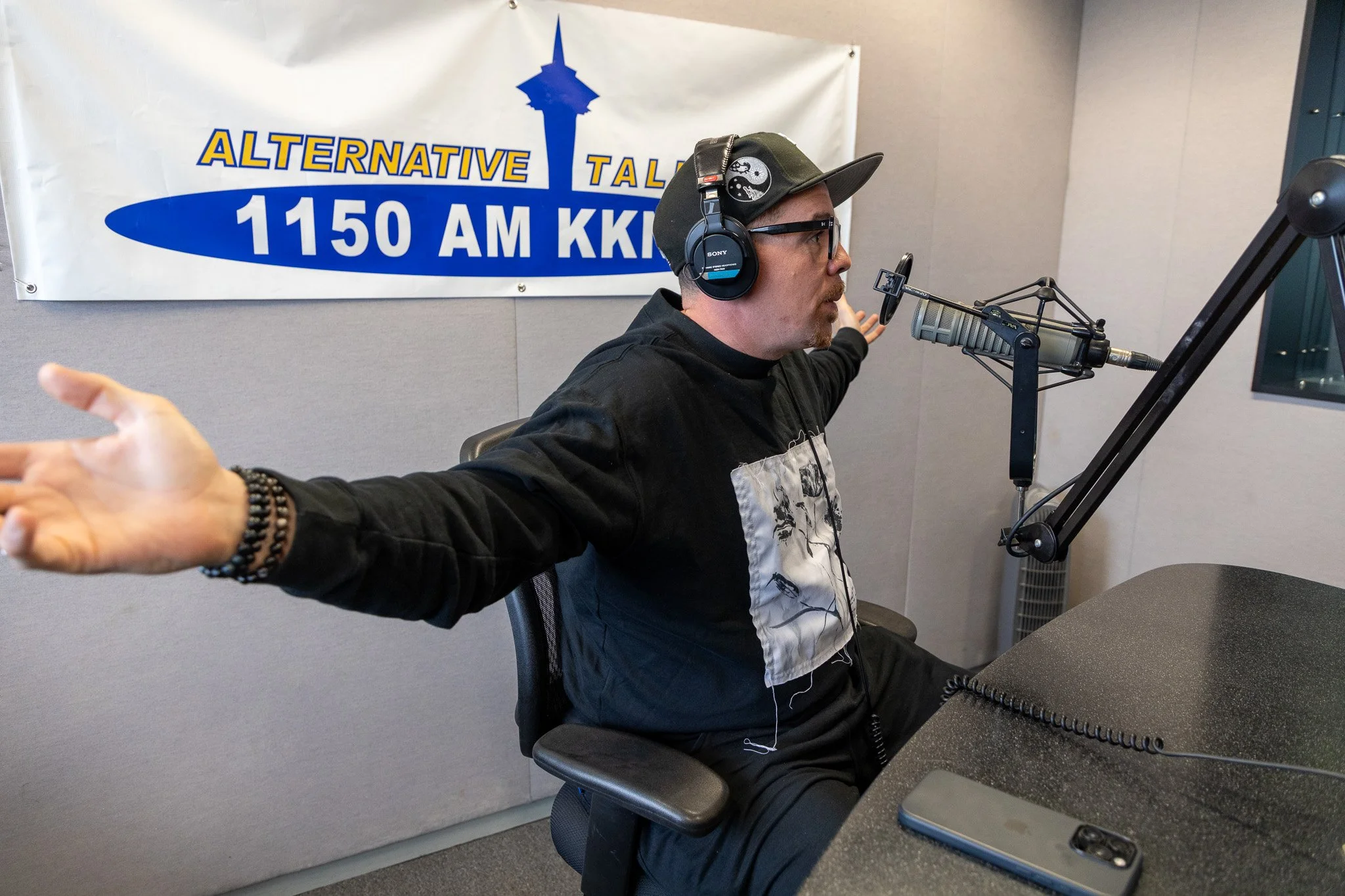
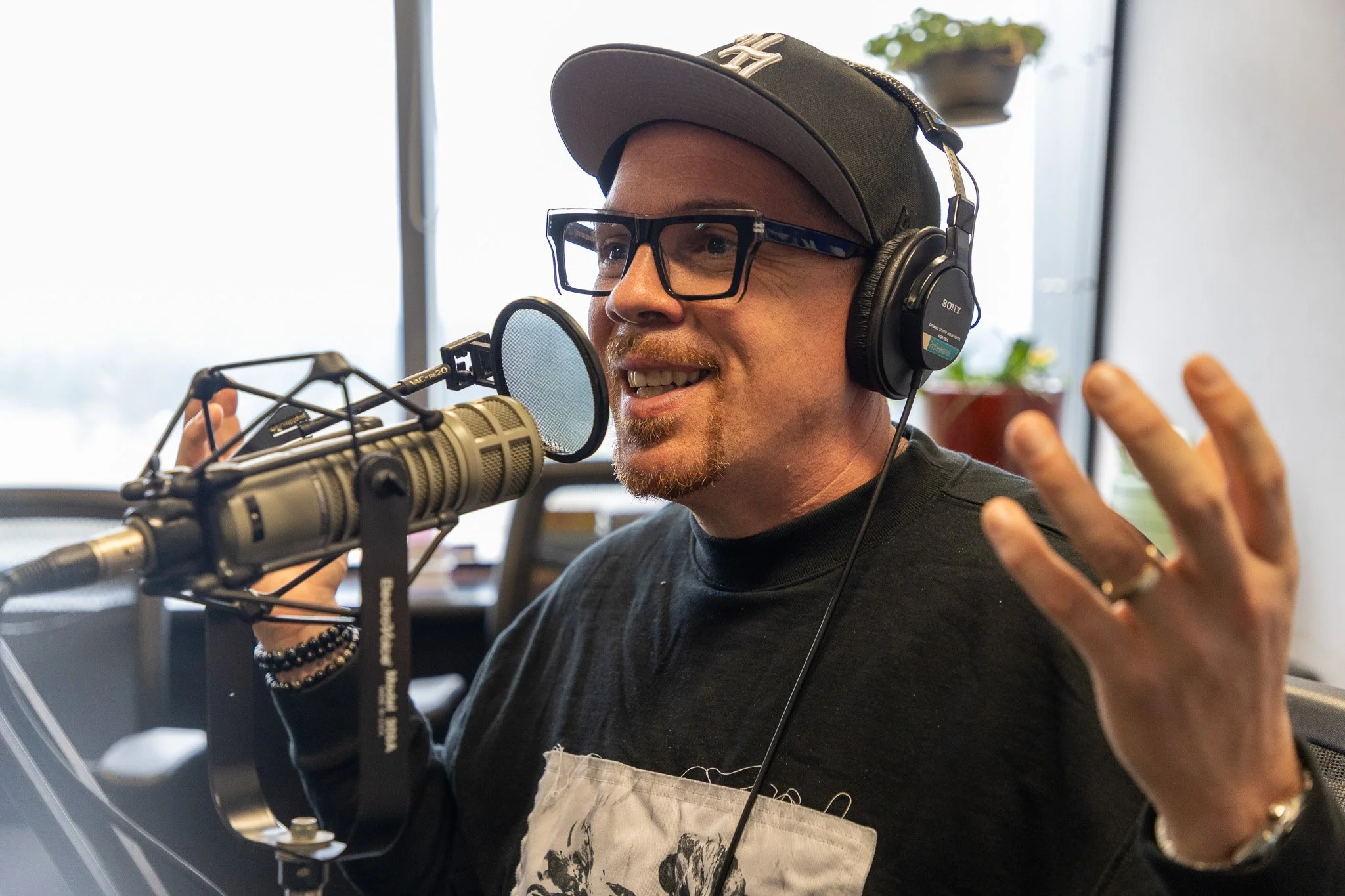
Sean Goode talks on air in the 1150 KKNW Studio on Monday. (Photo: Erik Kalligraphy)
On this week’s episode of The Mother’s Justice Show, host Omari Salisbury filled in for Rev. Harriett Walden to hold space with Sean Goode, the founder of Movement Makers, a TED speaker, and a lighthouse for youth and gun violence prevention work. What unfolded was an exploration of identity, trauma, and the collective effort required to heal as men, as Black individuals, and as a community.
Movement Makers: The Journey from Performance to Presence
Goode’s mission through Movement Makers sits at the edge of leadership and grace. He challenged the fundamental way many people, especially those in Black bodies, navigate the world through performance. From a young age, individuals are often taught to perform toughness to survive or softness to appease.
“Particularly Black-bodied folks, we learn how to perform from the minute we step up off the porch… masculinity, femininity, toughness, softness, smartness,” Goode said.
This performance often earns applause, but that very validation can drive individuals further from their true selves. Goode’s work is an invitation to return home. He focuses on those who are constantly holding space for others—the founders, the creatives, the healers—who rarely find themselves being held. He asked people to prioritize presence over performance.
“How can I be present before I perform? How can I be still before I act? How can I be curious before I’m critical?” he said.
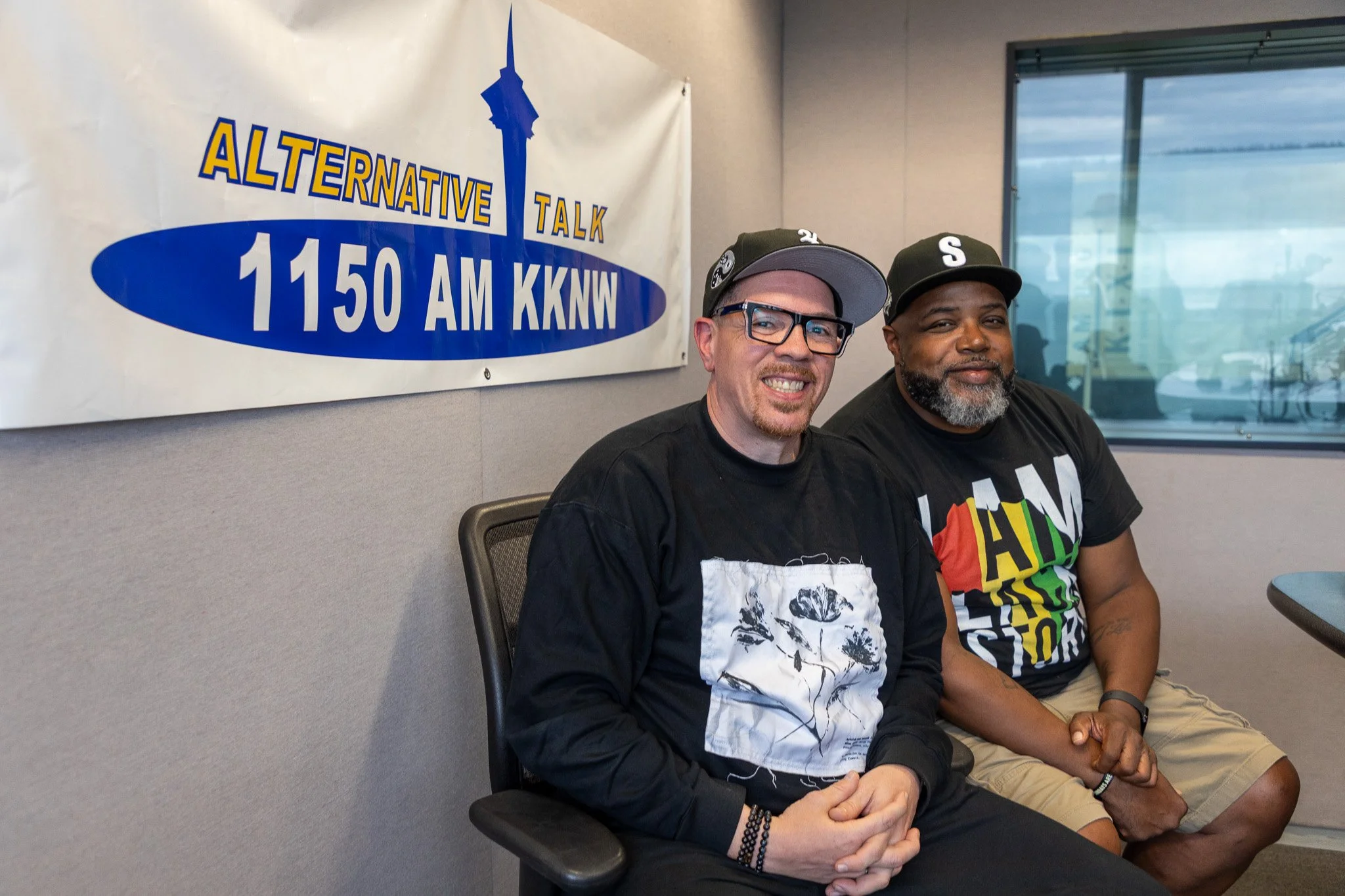
Sean Goode (left) and Omari Salisbury (right) pose in the Hubbard Radio Seattle Studio on Monday. (Photo: Erik Kalligraphy)
Healing the Root of Youth Violence, Not the Symptom
With over twenty years in the trenches of outreach and juvenile chaplaincy, Goode spoke on youth gun violence with the weight of memory. He pointed out a painful dichotomy: while national murder rates are declining, local youth-involved violence remains staggering. His critique is directed at current systems of funding.
“The solutions… continue to meet the symptomatic concerns,” he said. “We’ve yet to fully invest in root cause, and as a result, continue to find ourselves having conversations like this.”
The root cause, Goode argued, is a disconnection. Youth aren’t just disconnected from the community; they are disconnected from themselves, performing identities of violence because they feel fundamentally insecure.
“People say this is a really disconnected generation. What I’d offer is… they feel really disconnected from themselves… and feel deeply insecure, and as a result, find themselves performing identities that aren’t theirs.”
This leads to what Goode identified as the most challenging aspect: the responsibility of the adult. The community cannot expect wholeness from its children if adults do not model it themselves. When Salisbury asked why Goode shifted his focus from youth work to working with adults, his answer was direct.
“It’s the adults, Big O. It’s us,” he said. “I can’t see a young person as whole unless I see myself as whole… it’s the harm that [adults are] causing inadvertently by not witnessing the wholeness of young people.”
The House of Mirrors and the Distortion of Identity
To illustrate this fractured reality, Goode used the metaphor of a house of mirrors. If a young person has never seen a true reflection of their worth, they will wander through a world of distorted mirrors, looking for whichever one makes them feel powerful in the moment, even if that power is rooted in fear.
“Have you ever walked into one of those houses with many mirrors?” Goode asked. “If you don’t actually know what it is that you look like… then you move through the world in a house full of mirrors looking for the one that proportions you in what’s appealing in the moment. This is where our young people find themselves at.”
Omari Salisbury (left) and Sean Goode (right) talk in the 1150 KKNW Studio on Monday. (Photo: Erik Kalligraphy)
Men’s Mental Health: What the Body Holds
In honor of Men’s Mental Health Month in June, Salisbury and Goode delved into the specific trauma of Black men. Goode shared how his mother taught him to “box up” trauma to survive childhood.
“What she effectively did was teach me how to forget, which means I’ve had a really difficult time the entirety of my life remembering,” he said.
But while the mind forgets, the body is a meticulous record-keeper.
“The body remembers, and we’re lucky the body remembers, because the body tells us the parts of us that still need to be reconciled… It’s why we got short tempers, why we flash, why we don’t have the emotional depth to draw from,” he said.
Hiram’s Legacy: Radical Love and Pride
Salisbury spoke of his brother, Hiram, who died of HIV/AIDS 21 years ago. Hiram existed in a world that often had no home for him, rejected by Seattle’s Central District for being gay and by the city’s Capitol Hill neighborhood for being Black. Salisbury’s mother, Rev. Walden, responded by turning their home into a sanctuary for queer youth.
This legacy of radical hospitality is the bedrock of Salisbury’s work today. Hearing his Converge colleague Deaunte Damper, this year’s Seattle Pride Grand Marshal, invoke Hiram’s name during Pride was a moment of sacred return.
“Everything in nature is a circle, which means we’re never really arriving, and we’re always returning… I’d like to believe that your brother is here… The distance between now and then, a blink of an eye,” Goode said to Salisbury.
A Final Call to Return Home
Ultimately, the conversation was a call for self-recognition. Goode reminded the audience that the self-help industry often tries to sell people what they already possess.
“Everything manufactured has to be maintained… The self-help industry… can only promise you what it is that you already have… The minute you recognize it’s yours, you don’t need the machine,” he said.
The discussion closed with an appeal to support local Black media, not as an act of charity, but as an investment in collective survival.
“Go to WhereWeConverge.com, click on ‘Donate,’ and put in a number that honors your intention… do it for Reverend Walden… who planted the seed of this son that gets to sit across from me,” Goode said.
Learn more about Movement Makers at movementmakers.us
Tune in to The Mother’s Justice Show Mondays from 2 p.m. to 3 p.m. on 1150 AM KKNW.
Did you enjoy this blog post? Then consider donating to Converge and supporting our mission here.